
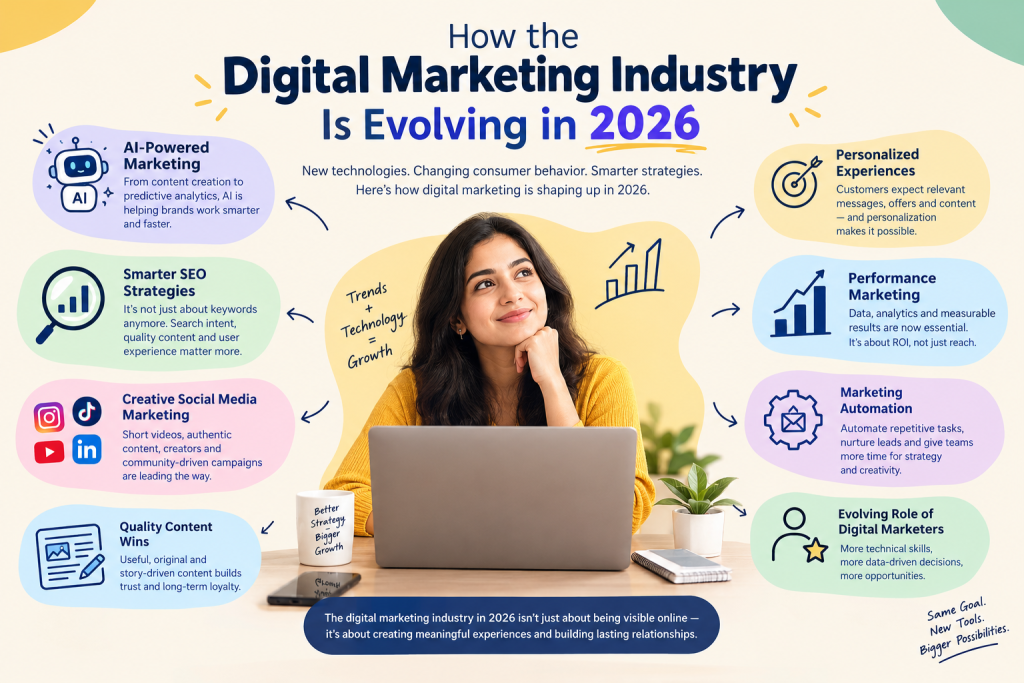
The digital marketing industry in 2026 is evolving faster than ever. New technologies, changing consumer behavior, artificial intelligence, automation, and data-driven strategies are transforming the way businesses attract, engage, and retain customers.
A few years ago, digital marketing mainly focused on search engines, social media, email campaigns, and paid advertising. Today, businesses need to think beyond traditional channels. Customers expect personalized experiences, faster responses, useful content, and meaningful interactions across multiple digital platforms.
For marketers, this means that simply running advertisements or publishing social media posts is no longer enough. Businesses need a smarter and more integrated digital marketing strategy.
1. AI Is Transforming Digital Marketing Digital Marketing Industry in 2026
One of the biggest digital marketing trends 2026 is the increasing use of artificial intelligence.
AI is helping marketers with content creation, audience research, customer segmentation, campaign optimization, predictive analytics, chatbots, and marketing automation.
AI-powered tools can analyze large amounts of customer data and identify patterns that may be difficult to detect manually. Marketers can use these insights to understand customer behavior and create more relevant campaigns.
However, AI is not completely replacing marketers. Instead, it is becoming a powerful assistant that helps marketing professionals save time and make better decisions.
The future of AI in digital marketing will likely focus on combining automation with human creativity, strategy, and emotional understanding.
2. SEO Is Becoming More User-Focused
SEO trends 2026 are moving beyond simply targeting keywords and building backlinks.
Search engines are becoming increasingly focused on understanding search intent, content quality, relevance, and user experience. At the same time, users are discovering information through traditional search engines as well as social platforms, AI-powered search experiences, videos, and online communities.
This means businesses need to create content that genuinely answers users’ questions rather than simply inserting keywords into articles.
Modern SEO strategies should focus on:
- Search intent
- Helpful and original content
- Topic authority
- Website experience
- Technical SEO
- Internal linking
- High-quality backlinks
- User engagement
- Structured and easily understandable content
For businesses, SEO remains an important long-term component of the future of digital marketing.
3. Social Media Marketing Is Becoming More Creative
Social media continues to play an important role in digital marketing. However, audience expectations are changing.
Users are consuming more short-form videos, educational content, behind-the-scenes content, creator content, and interactive posts.
The social media marketing trends 2026 landscape is increasingly focused on authenticity and community rather than simply gaining followers.
Brands are experimenting with:
- Short-form videos
- Educational reels
- User-generated content
- Influencer collaborations
- Interactive stories
- Social commerce
- Community-based marketing
- Personalized content
Brands that understand their audience and create content that provides entertainment, education, or value are more likely to build long-term engagement.
4. Personalization Is Becoming Essential
Customers don’t want to feel like they are receiving the same message as everyone else.
Personalized marketing allows businesses to deliver relevant messages based on customer interests, behavior, location, previous interactions, and purchase history.
For example, an e-commerce company can recommend products based on what a customer previously viewed or purchased.
With AI and advanced analytics, personalized marketing is becoming easier to implement at scale.
In 2026, businesses that effectively combine customer data with personalization can create better customer experiences and improve conversion rates.
5. Performance Marketing Is Becoming More Data-Driven
Another important development in the digital marketing industry in 2026 is the growing importance of performance marketing.
Businesses increasingly want measurable results from their marketing budgets. Instead of focusing only on impressions or followers, marketers are analyzing metrics such as:
- Cost per lead (CPL)
- Cost per acquisition (CPA)
- Return on ad spend (ROAS)
- Conversion rate
- Customer acquisition cost (CAC)
- Click-through rate (CTR)
- Customer lifetime value (CLV)
Platforms such as Google Ads and Meta Ads continue to provide businesses with opportunities to reach highly targeted audiences.
However, successful paid advertising now requires more than simply increasing the budget. Creative testing, audience analysis, landing-page optimization, conversion tracking, and campaign experimentation are becoming increasingly important.
6. Content Marketing Is Moving Toward Quality
Content marketing is also changing significantly.
Businesses are producing huge amounts of content, making it increasingly difficult for generic articles and repetitive social media posts to stand out.
The content marketing trends 2026 landscape emphasizes original insights, expertise, storytelling, useful information, and strong brand identity.
Instead of creating content simply to fill a content calendar, brands should ask:
“Does this content solve a real problem for our audience?”
High-quality blogs, videos, case studies, guides, podcasts, newsletters, and social media content can help businesses build authority and trust.
7. Marketing Automation Is Saving Time
Marketing automation is another important part of the future of digital marketing.
Businesses can automate repetitive tasks such as email campaigns, lead nurturing, customer follow-ups, reporting, audience segmentation, and certain customer-service interactions.
Automation allows marketing teams to focus more on strategy and creativity while technology handles repetitive processes.
When combined with AI, automation can become even more powerful by helping businesses deliver the right message to the right customer at the right time.
8. The Role of Digital Marketers Is Changing
As technology evolves, the responsibilities of digital marketers are also changing.
Marketers increasingly need a combination of technical, analytical, creative, and strategic skills.
A modern digital marketer may need knowledge of:
- SEO
- Google Ads
- Meta Ads
- Social media marketing
- Content marketing
- Analytics
- AI tools
- Marketing automation
- Conversion optimization
- Data analysis
The ability to understand data and turn it into actionable marketing decisions will become increasingly valuable.
Conclusion
The digital marketing industry in 2026 is becoming more intelligent, personalized, automated, and data-driven. AI, SEO, social media, performance marketing, content marketing, and automation are changing how businesses connect with their audiences.
But technology alone will not guarantee marketing success. Brands still need creativity, strong communication, customer understanding, and a clear strategy.
The biggest opportunity for businesses is to combine emerging technology with a human approach. Marketers who continuously learn, experiment, analyze results, and adapt to changing consumer behavior will be better prepared for the future.